Tag Archives: OFW Singapore

Home, Until We Are Home.

What Is Home To You?

“When I think of home, I think of a place where there’s love overflowing”

Years ago I rendered a speech about HOME and that line from the song has been my intro. For years, the words of that song has always been how I believed what home is – a place where there’s love overflowing. After attending the launch of Homes We Carry: Voices From Life Beyond Borders, they carried a different weight

I thought I was attending a book launch. Instead, I found myself listening to the heartbeat of thousands of migrant workers.
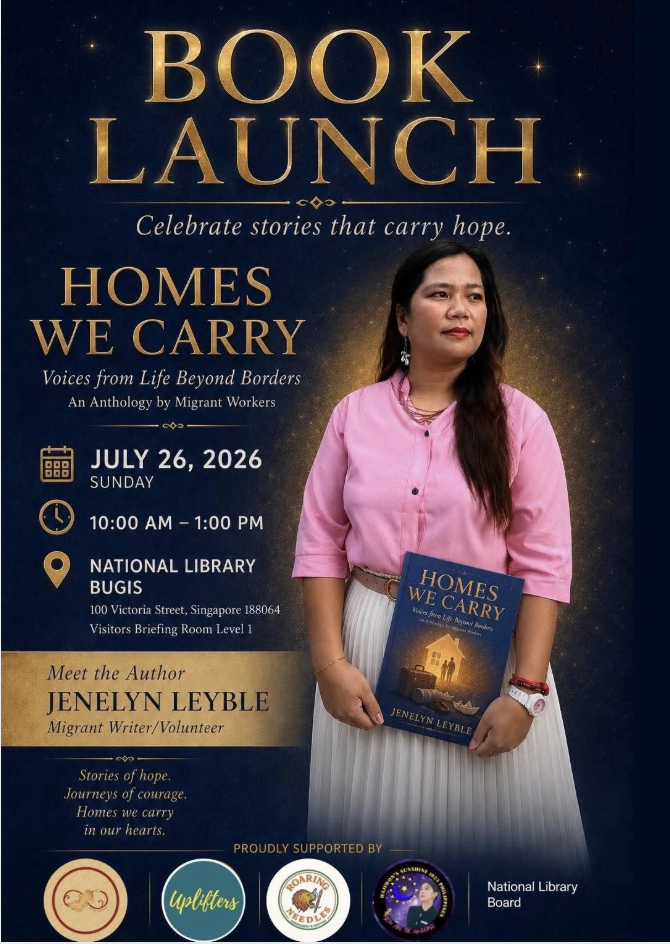
The author is a Filipino domestic helper in Singapore. What inspired me most wasn’t simply that she fulfilled her lifelong dream of publishing her first book. It was that she refused to let her circumstances determine the size of her dreams. Even more remarkable, she didn’t keep that dream to herself.

She invited fellow migrant workers to become co-authors—to tell their own stories, write their own poems, and give voice to lives that are too often overlooked. That, perhaps, is what dreams are meant to become. Not ladders that help us climb higher than everyone else. But doors that allow others to enter.

A Song That Felt Like Home

The morning started with an inspirational song. Instead of singing a contemporary worship song, the guest artist chose Ugoy ng Duyan. She shared how it was the lullaby her mother sang to her as a child. Although it is a Kundiman, this morning, it felt almost like a prayer.

As the familiar melody filled the room, I looked around and saw many of our fellow Filipinos quietly wiping away tears. It was no longer just a song. It became every bedtime memory. Every mother’s embrace. Every childhood we wished we could visit again.

Even more touching was hearing one of the guest speakers, a Singaporean poet, novelist, and illustrator, say afterward that although he didn’t understand a word of Tagalog, he could still feel the warmth carried by the music.

The Homes We Carry

Throughout the event, different speakers shared thoughts that stayed with me.

One poet spoke about missing “the ring of your language” …  “the slow embrace of love and the love of small embraces.”

Another reminded us, “If you were born into this world, you were meant to be here.”

An Indonesian Embassy representative challenged us to “create homes through kindness.”

Those words beautifully echoed what this entire book is about.

The opening poem by the author describes learning to “dance to the rhythm of survival”, turning longing into strength and discovering that home is no longer merely a place left behind, but something carried in every sacrifice, every remittance, every whispered prayer before sleep.

Those lines capture the life of so many Migrant Workers. Home travels with them. Not in their luggage. But in their hearts.

“Uwi Ka Na, Mama”

Among all the poems, one quietly broke my heart. It was written by someone I have known in church for years. The title was Uwi Ka Na, Mama.

She left for overseas work when her daughter was only one year old. She has now spent more than twenty years working abroad. She recalled the day her little girl, only seven years old then, cried over and kept repeating, “Uwi ka na, Mama.” Come home, Mom.

She shared that even today those words still pierce her heart. Perhaps that is the hidden cost of migration.

People often see the remittances. They celebrate the opportunities. They admire the resilience. But behind every successful migrant worker is usually…

A birthday missed.

A graduation watched through a screen.

A child who learned to grow up while waiting.

A spouse who carried responsibilities alone.

Parents who grew old while hoping the next reunion wouldn’t be years away.

It is a sacrifice few people truly see.

Home Is More Than A Place …

For years I have believed that home is not simply a place. It is not a location marked on a map.Like the song says, home is where love overflows.

Home can be people.

Home can be memories.

Home can be experiences.

Home lives inside us.

A home is not built only with bricks and walls. It is built through friendships that become family.Communities that embrace us. Churches that pray for us. Employers who believe in us. Neighbors who show kindness. Simple moments that remind us: You belong here.

Perhaps that is why so many migrant workers eventually discover a “home away from home.”Singapore has become that for many of us. Not because it replaced the Philippines. But because we have found people here that chose kindness. People who welcomed us.

Worked alongside us.

Believed in us.

Prayed with us.

Loved us.

In doing so, they helped build another home.

… And Yet Home Is Also A Place

Yet if I am honest, there is another truth I cannot ignore.

Just last week I flew back to the Philippines. The moment the plane touched down, the cabin suddenly erupted in applause and cheers. Many of the passengers were Overseas Filipino Workers returning from the Middle East. Some had not gone home for maybe two years or perharps even longer. One voice shouted,

“Sa wakas… pagkatapos ng mga pagtitiis.”

Finally… after all the sacrifices.

At that moment I realized something. Yes, home is more than a place. But for those who have lived apart from their spouses … For mothers who have missed watching their children grow… For fathers who know their sons and daughters mostly through video calls… For children waiting for one more embrace… Home is also very much a place.

It is still the embrace of loved ones.

The dinner table where everyone is finally complete.

The familiar voices echoing through the house.

No matter how beautifully we describe home as something we carry inside us, my heart still aches for every migrant worker who longs to be home, in the arms of the people they love

Perhaps both things are true.

Home is what we carry.

And home is who we long for.

Until We Are Home

As the book launch came to an end, I realized this book is about far more than migrant workers.It is about every human heart searching for belonging.

Perhaps that is why Scripture repeatedly speaks of us as sojourners and pilgrims. We are all carrying a longing for home. Not just an earthly one. But an eternal one. Until then, may we become the kind of people who create homes through kindness.

Who welcome the stranger.

Who make room at the table.

Who help someone feel less alone.

Because sometimes the greatest gift we can offer another person is not a house.

It is the feeling that they belong.

“Consequently, you are no longer foreigners and strangers, but fellow citizens with God’s people and also members of his household.” – Ephesians 2:19

May we continue building homes, not only with walls, but with love.

Because in the end, the most beautiful homes are the ones we carry within us… until we finally arrive home.

One Sunday in Hong Kong : Karton, Kwento, Kabayan.

Banig ang kama. Karton ang dingding. Kalye ang tahanan.

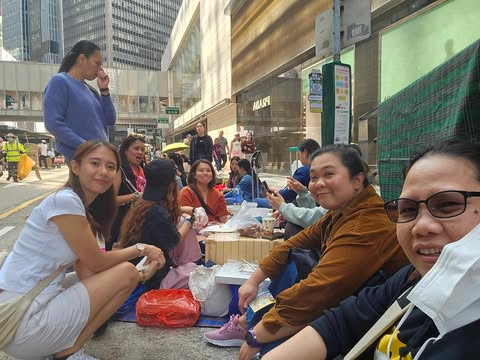
It may sound poetic, but this is not a metaphor. This is the literal Sunday reality of many of our kababayans in Hong Kong, our dear Filipino domestic workers whose day off is spent on sidewalks, beneath tall skyscrapers and luxury malls, forming makeshift ‘homes’ just for a day of rest and belonging and to feel home.

I recently went to Hong Kong, not as a tourist but as a friend, listener, and burden-bearer. The trip opened my eyes wider than ever before. I’ve seen Filipinos everywhere (coz we are practically everywhere), Singapore, the Middle East, Europe, but something about Hong Kong broke my heart in a different way.

It all began with a dream. not mine, but a friend’s.

Yayie, who once lived and worked in Singapore, reached out to us with a burden burning in her heart. She dreamed of starting a “high quality” agency in Hong Kong. not just to process paperwork, but to truly help and empower our kababayans. Her vision was deeper than logistics; it was about restoring dignity

We mentioned this to our life coach, who said something simple yet weighty:
“Sige na, gawin niyo na ‘yan. Ang tagal niyo na rin iniisip.”
That one sentence sparked movement.

Not long after, during one of the sessions in our Prayer & Fasting, Coach Albert shared about the work being done in Bicol. His message stirred something in me. It was missional, not just in geography, but in heart. Just like what we’ve been doing in Singapore – bringing the church to where people are.

And when my eyes met Dina’s, it was clear: we were thinking the same thing.
“Tara, book na tayo ng flight. Hong Kong na.”

We weren’t sure what would come out of this. There was no big program, no formal agenda. We simply wanted to catch up with friends. But deep inside, we knew we were also being led perhaps to see, to listen, and to carry a piece of our kababayans’ burden.

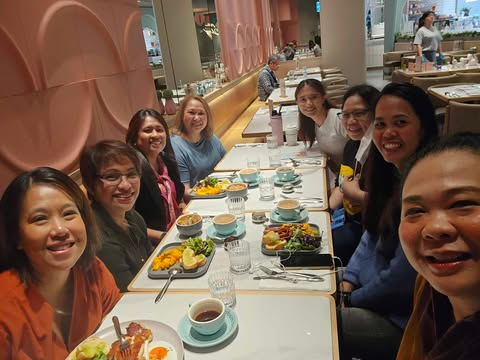
On our first morning in Hong Kong, we met with two old friends over breakfast. The hugs were tight, the tears came fast. It didn’t take long for the burdens to surface.

One of them, once a business owner and proud mother of a college graduate, is now back working as a domestic helper. Life back home took unexpected turns, covid killing the business, financial loss, illness,  and the need to start over. Her story, like so many others, was layered with quiet strength and quiet heartbreak

But more than the details of their past or present, what struck me most was the emotion, raw, unfiltered, and very real. The pain of being misunderstood by employers. The deep loneliness. The fear of sudden contract terminations without recourse. The weight of having to provide for a family while enduring verbal abuse and being made to feel small.

There were phrases I heard that still echo in my mind:
“Durog na durog ang pagkatao ko.”
“Wala ka namang laban.”
“Kailangan kong tiisin.”

Sometimes, it’s not even the physical labor that’s the hardest. It’s the emotional wear and tear, the quiet erosion of one’s dignity.

Between Skyscrapers and Cardboard Walls.

Sundays in Hong Kong are different. Especially in Central. The streets transform not into markets or festivals but into makeshift neighborhoods. Folded cardboard becomes flooring. Banigs are unrolled like red carpets. Umbrellas and boxes become walls. And amid the towering silhouettes of Dior, Louis Vuitton, and glassy malls, our kababayans sit cross-legged on concrete, eating packed meals, getting haircuts, painting nails, doing each other’s makeup. Laughing. Singing. Resting. Trying to experience the feeling of being at home.

It’s their day off. the day when the helper becomes her own person again, even if just for a few hours.

And yet, the contrast is jarring. Right in the heart of luxury, our people settle on the streets. Not by choice, but because there’s nowhere else to go. They say it’s not illegal to enter malls, but there’s a quiet message that whispers, “You don’t belong here.”

We walked along the closed-off streets, where the government had designated a space just for them. In a way, it felt like a gift. But in another way, it felt like a boundary line … “You can stay here, but don’t go beyond.”

Inside Worldwide House, the unofficial Filipino center, the atmosphere was electric and overwhelming. Crowds. Shouting. The hustle of side hustles – food, accessories, anything you can sell. It felt like a market and a neighborhood rolled into one. And yet, something in me quietly ached.

Twenty years ago, when I first visited Hong Kong, I had seen scenes like this. I thought things might’ve changed. But nothing much has. If anything, there are more people now. And deeper stories behind every smile.

It looked like joy, and maybe it was. But it also looked like survival dressed up in Sunday best.

Joy or Resignation?

At first glance, it felt like a celebration.

There was laughter, food, music, and a sense of togetherness that was undeniably Filipino. It reminded me of Sundays in Singapore too, our kababayans laying out mats, sharing meals, trading stories. But something about Hong Kong struck a different chord.

It felt heavier. Louder. And strangely, lonelier.

As we sat with some of the women, I noticed their eyes, they sparkled when they talked about shopping, video calls with their kids, and the dollar exchange rate. “Okay naman kami dito,” one said. “Masaya naman. Malaki sweldo.”

And yet I couldn’t shake the question in my heart:
Is this happiness? Or is this what happens when hope gets boxed up like the balikbayan boxes they pack every Sunday neatly taped and tightly sealed?

Maybe we’ve learned to celebrate just to survive. Maybe the laughter is real, but so is the exhaustion, the pain that’s too deep to put into words. Maybe some of us have accepted that “ito na kami.” This is what life is now. Earn, send, survive, repeat.

But what if it’s not supposed to stop there?

One of our friends said something that pierced me: “Ate, wala naman kasing ibang nadidinig.” Probably no one’s telling them there’s more. Probably no one’s reminding them that they’re not just workers, but women of worth. Not just survivors, but dreamers. Not just remittance senders, but nation-builders, whose dignity shouldn’t be traded for dollars.

And so we walked. We listened. We laughed. We sat on sidewalks and in stuffy corners. We took it all in, the noise, the numbness, the reality of it all. We didn’t have answers. We didn’t go there to fix anything.

When the noise faded and the day wound down, what remained was a gentle nudge in my heart … a soft whisper that this mattered. That they mattered.

I left Hong Kong with a full stomach, oh yes! we did eat well, so well!. But more than that, I left with a full heart. Full of stories. Faces. Tears. Laughter. And questions I still can’t answer.

I didn’t come home with a strategy. I came home with a seed.
A seed of longing.
That somehow, someday, we can help.
That maybe, one day, the little things we carry, our skills, our connections, our faith, our presence can be planted in the lives of our kababayans who feel stuck in survival.

I don’t know what that will look like yet. I don’t know how, or when, or with whom. But I carry the hope that what we saw and felt in those streets and crowded corners was not the end of the story. Maybe it was just the beginning of one.

For now, all I can do is pray.
And dream.
And believe that when the time is right, we will put hands and feet to the dream. Maybe not all at once. But one step. One heart. One life at a time.

One life at a time.

“For the vision is yet for the appointed time; it hastens toward the goal and it will not fail. Though it tarries, wait for it; for it will certainly come, it will not delay.” – Habakkuk 2:3